What Investing is All About
As I’ve gotten older, I have felt (finally) an elevated clarity regarding this question. And relatedly, perhaps an elevated awareness of how little that goes on in the broader world of investment markets could really be considered “investing.” I believe answering this question is tremendously important, yet it remains woefully misunderstood. So - what is investing all about? I believe it’s really quite simple:
Investing involves reflecting upon all the various opportunities available to someone where they can deploy their capital - whether that’s a CD, a bond, a business, a rental property, a farm, etc - and then selecting those that a) promise to generate the highest amounts of cash flow or profits over the next 10-50 years, all while balancing that against b) the confidence you have in these individual projections.
Said another way, investing is about getting the highest return on your capital that you feel the most certain about. And this isn’t just my opinion. Here are some quotes from Warren Buffett, the greatest investor the world has ever seen:
“It all relates to cash flows. The only reason for putting cash into any kind of an investment now is because you expect to take cash out. Not by selling it to somebody else - because that’s just a game of who beats who - but by, in a sense, what the asset itself produces. That’s true if you’re buying a farm, it’s true if you’re buying an apartment house, it’s true if you’re buying a business……………..that’s what the game of investment is all about. Investment is putting out money to get more money back later on from the asset, not by selling it to somebody else, but by what the asset itself will produce.”
In the 1992 Berkshire shareholder letter, Buffett wrote this:
“In The Theory of Investment Value, written over 50 years ago, John Burr Williams set forth the equation for value, which we condense here: The value of any stock, bond or business today is determined by the cash inflows and outflows - discounted at an appropriate interest rate - that can be expected to occur during the remaining life of the asset. Note that the formula is the same for stocks as for bonds. The investment shown by the discounted-flows-of-cash calculation to be the cheapest is the one that the investor should purchase - irrespective of whether the business grows or doesn’t, displays volatility or smoothness in its earnings, or carries a high price or low in relation to its current earnings and book value.”
To me, that captures everything. Investing is deploying cash today into the assets available to you that promise the highest cash flows back to you in the future. In effect, if you could know the income stream over the next 50 years on every asset available in the world - CDs, bonds, rental houses, private businesses, stocks of companies - you would simply want to purchase the ones that offer the highest cumulative amounts of income relative to the purchase price (we’ll leave the technicalities of discounting aside for the moment). That’s the entire game. If two businesses were each available for $1 million and Business A would produce cumulative income of $15 million over the next 50 years and Business B would produce $400 million - an investor would obviously prefer B. It doesn’t matter if Business A cures cancer or invents AI, or if Business B collects trash; the true investor is largely agnostic about the various ways the cash itself is produced (obviously excepting illegal, unethical, or immoral sources).
Investing isn’t a popularity or vanity contest. It’s rather a very logical application of sensible business behavior. Ben Graham said it best when he commented that “investment is most intelligent when it is most businesslike.” Many people seem to believe that the secret to successful investing is to simply buy the most popular companies in the most popular industries, without really much consideration to price paid and what the 50 year income stream will look like. The decision is simply → popular stock → it will probably go up → end of reasoning. That isn’t investing. It’s speculating, and it might work, but it isn’t intellectually defensible and over the long-term will produce results comparable to gambling.
Consider one example that pushes against the narrative of only buying high-growth tech companies. We bought a large position in a small bank (FMCB) in 2025 for $1,000 a share. At the time, they were earning $32.86 per quarter or around $131 per year (that annual profit works out to a 13% earnings yield on the $1,000 purchase price). Let’s compare them against AMD, a very popular tech company today. In 2025 AMD earned $2.65 per share in profits, and the share price as of this writing is $518.58 (this works out to a 0.51% earnings yield).
Let’s imagine you invested $1 million into each of them. In year 1, your FMCB investment would produce $131,000 of profit, whereas your AMD investment would produce about $5,110 of profit. Now, let’s go out 30 years and assume 9.2% profit growth for FMCB (roughly their 26 year average), and let’s assume 20% growth for AMD (a very difficult growth rate to maintain!). Look at the yearly profits produced on your $1 million investment over three decades as well as cumulative profits. Which business do you want?
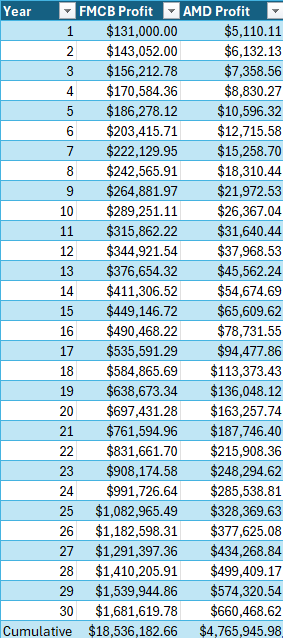
The point here is that no matter how “great” a business is, the price you pay to obtain it is very important. AMD has to increase profits almost 2500% (!) just to catch the profits FMCB is producing on day one. And while AMD will grow profits faster, FMCB also growing their profits means AMD is chasing a moving target; indeed, in this exercise, AMD never actually catches FMCB even while having twice the growth rate. If you carry this exercise out further, AMD yearly profits don’t pass FMCB until year 49 and cumulative profits don’t eclipse FMCB until year 57. That’s……a long time - clearly longer than the time frame envisioned by the average investor holding a stock for a few months or a few years. A hypothetical 50 year old investor choosing AMD in this example would likely never see the day this even happens, and of course this ignores the extreme unlikelihood of a company compounding profits at 20% for 57 years (AMD’s profits in 57 years in this example would be $141 trillion - a number 4 times larger than the entire US economy today).
Wrapping Up
To quote Buffett once again:
“The most that owners in aggregate can earn between now and Judgment Day is what their businesses in aggregate earn. True, by buying and selling that is clever or lucky, investor A may take more than his share of the pie at the expense of investor B. And, yes, all investors feel richer when stocks soar. But an owner can exit only by having someone take his place. If one investor sells high, another must buy high. For owners as a whole, there is simply no magic – no shower of money from outer space – that will enable them to extract wealth from their companies beyond that created by the companies themselves.”
To tie that into the example above, while certainly someone can produce high investment returns by fortuitously buying or selling AMD, the most all AMD shareholders collectively can earn over the next 30-50 years is what AMD itself produces in the form of profits. The real investor is evaluating all available opportunities to deploy their capital and only choosing the ones where the future profits of that investment appear to be a) attractive in relation to the purchase price and b) possessing a likelihood of occurring that the investor is confident in. That’s what investment is all about.